


Buying commercial pizza equipment shouldn't start with choosing an oven. It should start with understanding what you actually need to make your operation successful.
When a new pizza oven arrives in a commercial kitchen, the expectation is often that training begins there and then.
🤔How do you switch it on?
🤔What temperature should it run at?
🤔How do you use the controls?
🤔How do you clean it?
All important questions, of course. But at LLK, we believe the conversation around training needs to start much earlier.
For pizza in particular, the right equipment, the right process and the right training are all connected.
Pizza is not one product.
A Neapolitan pizza operation has very different requirements to a New York-style, Detroit, Roman or high-volume pizza-by-the-slice operation. Dough formulation, hydration, fermentation, cooking temperature, volume, workflow and staffing can all influence the equipment required.
That means choosing an oven shouldn't simply be a case of looking at its size, temperature or specification sheet.
The dealer needs to understand what the customer is trying to achieve.
This is where we believe dealers have a particularly important role to play. Having a strong understanding of the equipment range and how different machines perform in different applications allows the dealer to guide the customer towards a solution that is appropriate for their operation.
And sometimes, the best way to establish that is to get the customer in front of the equipment.
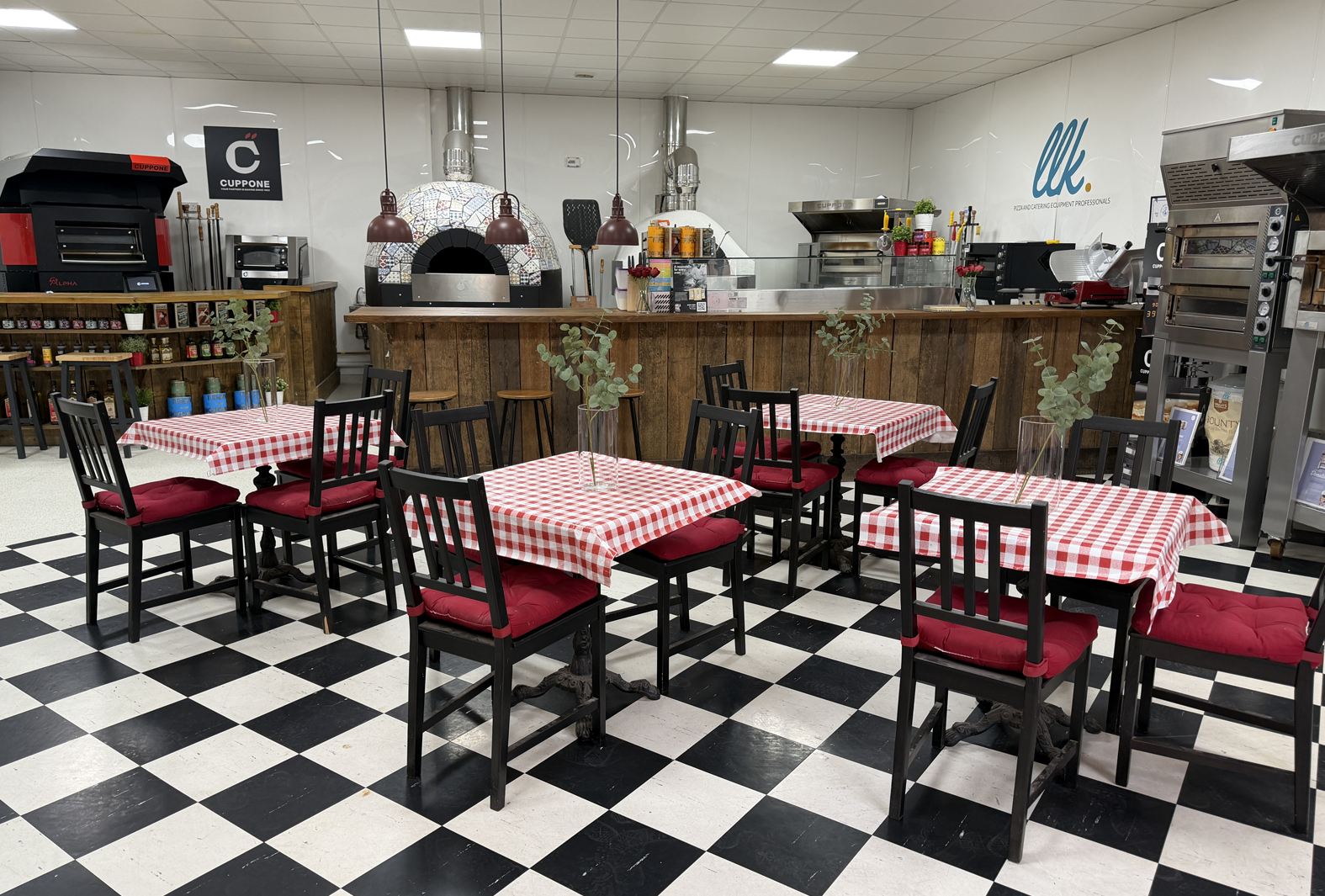
At the LLK demo kitchen, demonstrations aren't simply about showing customers how impressive an oven is.
They're an opportunity to ask questions.
🤔What pizza are you planning to produce?
🤔How many pizzas will you need to produce?
🤔Who will be operating the equipment?
🤔How experienced is the team?
🤔What does the kitchen workflow look like?
🤔What happens during your busiest service?
Most importantly, it gives customers the opportunity to get hands-on with the equipment before committing to it.
That experience can change the conversation considerably.
Customers can understand the differences between machines, see what is achievable and, in some cases, discover that what they originally thought they needed isn't necessarily the best solution for their operation.
It also allows LLK to understand the customer better.
And that leads to another important conversation: how much support will they actually need?
Not every customer needs the same level of training.
Someone who has operated commercial pizza equipment for years may simply need product-specific training.
Someone opening their first pizza operation may need considerably more support.
They may need help with dough management, recipe development, fermentation, workflow, production processes, staff training and SOPs, as well as understanding the equipment itself.
There is a huge difference between showing someone how to operate an oven and helping a new team become confident and competent in running a pizza operation.
Neither is necessarily right or wrong. The important thing is understanding what the customer needs before the equipment is supplied.
This is an area where LLK believes the industry could do more, be more transparent and share the value in the investment.
Training and operational support should be discussed at the quotation stage and, where appropriate, factored into the project cost from the beginning.
Why?
Because there is a significant difference between a couple of hours of product training, a full day's support and having someone work alongside a new team for several days.
If those requirements are only identified after the equipment has been installed, the customer may not have budgeted for the support they actually need.
It also creates the risk of the customer believing that "training" means a quick demonstration of the machine, when what they really need is a much more comprehensive programme to get their operation up and running successfully.
At LLK, the demo kitchen gives us the opportunity to have that conversation early. Once we understand the customer's operation and requirements, we can work with the dealer to recommend the appropriate equipment and the appropriate level of training and support to include within the proposal.
That makes the process more transparent for everyone.
One of the biggest challenges LLK sees isn't necessarily a lack of training. It's the loss of knowledge afterwards.
A team member receives training when the equipment is installed. Six months later, they leave. New staff arrive and suddenly the people operating the oven weren't the people who were originally trained.
It's an incredibly common situation in hospitality.
This is where accessible training materials become particularly valuable.
Clear SOPs, written guidance and practical training videos give teams something they can return to when they need a reminder. They also help dealers and customers pass knowledge on to new members of staff rather than relying on one person within the business to hold all of that knowledge.
LLK is continuing to develop its library of training and how-to content for exactly this reason.
Good training isn't just about producing a better pizza.
It can also help prevent avoidable service call-outs.
Pizza production is a skilled process. Some aspects require repetition and muscle memory, and those skills can't necessarily be developed during a 30- or 60-minute equipment demonstration.
Operators also need to understand how equipment should be used, cleaned and maintained.
When that knowledge isn't there, simple operational errors can sometimes be mistaken for equipment faults.
Better training can help operators recognise what is normal, identify potential problems earlier and avoid mistakes that could otherwise result in downtime or an unnecessary service call.
Perhaps the most important thing LLK tries to establish through its demonstrations is that there isn't a single "best" pizza oven.
There is only the right equipment for that particular operation.
The right oven for a high-volume chain may be completely wrong for an independent operator. The right training for an experienced pizzaiolo may be completely different from what a new team needs.
That's why the conversation needs to happen early.
The equipment, the product, the people and the processes all need to work together.
Ultimately, LLK believes the responsibility of suppliers and distribution partners goes beyond supplying equipment.
The goal should be to give the customer the best possible chance of success.
That means having knowledgeable dealers who can guide customers from the start. It means manufacturers providing the technical expertise and training to support that process. It means giving customers the opportunity to see and experience equipment before they buy it. And it means being honest about the level of training and operational support they may need.
A successful pizza operation doesn't happen simply because the right oven is sitting in the kitchen.
It's what happens around that oven that makes the difference.
Dealers, send your customers to our demo kitchen, so we can get it right from the start.
Customers, come along and learn how to get it right from the start, we will pair you up with the perfect partner for your project too!
BOOK HERE
LLK
Units 3-5 Belgrave Industrial Estate
Honeywell Lane
Oldham
OL8 2JP
0161 388 0321 (sales)
0161 696 0052 (service)
*CALLS ARE RECORDED FOR TRAINING AND QUALITY PURPOSES*
sales@llkpizzapros.co.uk
